November is an important time for war remembrance, at least in UK and other commonwealth countries. Two minutes silence falls every year on the ‘11th hour of the 11th day of the 11th month’ marking the exact anniversary of the armistice that brought an end to world war hostilities in1918. The month is also marked by the wearing of poppies and more formal parades on the second Sunday in November. [1]
A focal point for remembrance in England is the laying of wreaths around the cenotaph in London. The cenotaph has an interesting history. It was originally made out of plaster and wood and hurriedly put up to support the ‘Peace Day’ celebrations in 1919. It was only intended to be a temporary structure but it proved so popular that a permanent replacement, constructed in stone, was immediately commissioned and unveiled by King George V in 1920.
The choice of an abstract cenotaph rather than a more representational or heroic sculpture captured the mood of the time for the public were all too aware of how many people had died in the war, often in terrible circumstances. The word cenotaph itself comes from the Greek ‘empty tomb’ and this also drew attention to the many bodies that were never recovered. There is little overt symbolism on the cenotaph allowing everyone to see it on their own terms. However, there is an inscription to ‘Our Glorious Dead’. This, at a pinch, is capable of varied interpretation, though one splinter group of anti-globalisation protestors found its sentiment was objectionable enough for them to spray-paint anti-capitalist and anti-war slogans on it in the May day riots of 2000. [2]
There are no names inscribed on the cenotaph but other war memorials do name war dead. For example, the huge Thiepval Memorial in Northern France carries the 72,337 names of missing British and South African servicemen who died in the Battle of the Somme, as does the giant socialist realist ‘Motherland Calls’ monument in Volgograd, which commemorates the dead in the battle of Stalingrad in the second world war. [3]
Of course, many local monuments to the war dead are simple affairs. We have a cenotaph in my local park erected after the first world war. Like the London cenotaph it has no names inscribed on it though this was apparently based on a fear that it would not be easy to verify who had a connection with Coventry and any missing names could cause offence to loved ones. The cost of this cenotaph was met by public donations – over £5,000 was raised and that would be £400,000 today, this in a city of 150,000. On the day of the dedication of the memorial around 50,000 people turned up.

Coventry’s own cenotaph, more often referred to as the war memorial
For those who have mixed feelings about cenotaphs, there are other ways to remember the war dead. For example, the park in which our cenotaph is placed was itself created as a memorial and around the trees there are plaques to, both civilian and armed services causalities over the years. In my city there is also a striking memorial to war victims in that the ruins of the old cathedral have been left as a reminder of the air raid of 14 November, 1940. The background here is that Coventry was the first UK city to be comprehensively blitzed by Hitler and a quarter of the city buildings, including the old cathedral were destroyed. [4] So impressed with the outcome was Joseph Goebbels that he later used the term coventriert (or we would say ‘coventrised’) to describe such a concentrated assault.

One of many plaques to remember soldiers and citizens who died in wars
In the cathedral ruins there is an inscription above what remains of the altar. The story is that the day after the Blitz, two half burnt roof-beams were bound and placed at the site of the ruined altar, along with three medieval nails found among the debris. On this makeshift cross Provost Dick Howard, who lead the cathedral at the time, wrote simply ‘Father Forgive’. A small act of remembrance and a commitment to reconciliation that has carried across the ages.
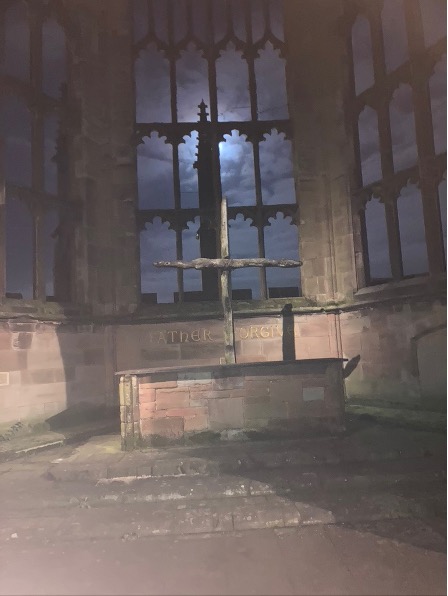
Old cathedral ruins Coventry, photo taken on the anniversary of the 14 November raid
It was Vygotsky who said that the noteworthy thing about memorials is not what they represent but the fact we put time and effort into erecting them in the first place. This was part of his argument that to understand human development you had to understand not only the physical tools but the concepts and ideas that each generations has inherited. Our task is to use all that is available to us from the past and refashion it in new ways. No pun intended, remembrance is not set in stone but there are stories that are worth remembering.
References
[1] Wikipedia gives a run down on remembrance day as practised in different countries: Wikipedia (last updated 2024) Remembrance Day [Online] https://en.wikipedia.org/wiki/Remembrance_Day
There is a teaching resource on remembrance for school children produced by BBC at: BBC (nd) Remembrance Day [online] https://www.bbc.co.uk/teach/school-radio/articles/znkxjsg
[2] If you are interested in the London cenotaph then the first part of Moffett’s paper provides an overview: Moffett, A. (2007) ‘We Will Remember Them’: The Poetic Rewritings of Lutyens’ Cenotaph. War, Literature & the Arts19, no. 1–2: 228-46.
The imperial war Museum web site has a couple of interesting historical photos of the cenotaph , go to Imperial War Museum (nd)What Is The Cenotaph? [Online] https://www.iwm.org.uk/history/what-is-the-cenotaph
[3] Go to Commonwealth War Graves Commission for a brief overview of the Thiepval Memorial:
Commonwealth War Graves Commission (nd) Thiepval Memorial [Online] https://www.cwgc.org/visit-us/find-cemeteries-memorials/cemetery-details/80800/thiepval-memorial/
Palmer’s paper on ‘The Motherland Calls’ is a very comprehensive study of the design and construction of ‘The Motherland Calls’ monument.
Palmer, S. (2009) How memory was made: The construction of the Memorial to the Heroes of the Battle of Stalingrad. The Russian Review 68, 3 (2009): 373-407.
[4] The death toll in the 14 November raid was a comparatively modest total of over 500 for it seemed that following smaller raids Coventry people had become used to trekking to the surrounding fields at night for fear of attack. In comparison the raid at the end of the war on the city of Dresden resulted in many thousands of deaths. I describe remembrance events in Dresden at https://caifonline.com/2024/02/28/the-power-of-silence/
[5] Coventry cathedral has a retelling of this story at: Diocese of Coventry (nd) The Story of the Cross of Nails [Online] https://www.coventry.anglican.org/the-story-of-the-cross-of-nails.php
 Michael Hammond